The Month-End Total Lied: Modeling Cash-Flow Timing in Tally & Trace
Our budget app faithfully computed a reassuring month-end total — and was blind to the mid-month moment where the bills come due before payday. Here's how we reworked the forecast engine to model the one number the spreadsheet actually existed to compute.
July 13, 2026 · 10 min read · Technical · By Seth
The whole point was to replace the spreadsheet
Tally & Trace exists to retire our aging Google Sheet budget. So when we sat down to plan the next round of work, we did something we should have done much earlier: we put the real spreadsheet next to the app and mapped every section across, cell by cell.
Most of it mapped cleanly. Salaries and rent are recurring budget entries. The line items on each credit-card statement are transactions that sum to the card's balance. Installments ("LG Washing Machine 4 out of 6") are budget entries with a fixed number of occurrences. Envelopes for cash and e-wallet spending are allocations. The app already had homes for all of it.
And then we got to the one number the spreadsheet exists to produce — and the app couldn't compute it at all.
The number that keeps us solvent
Our income is lumpy. The bulk of it lands on the last day of the month. But the bills — rent, and a stack of credit-card statements — are due between roughly the 21st and the 27th. Payday is after the money is already spoken for.
So the single most important thing the spreadsheet does is a timing check: take the starting balance, add only the income that arrives before the due dates, and confirm it covers everything due before then. If that check passes, we're fine. If it fails, we're overdrawn on the 24th no matter how healthy the month looks on paper — and we fall behind on payments, which for a household budget is the whole ballgame.
Here's a worked example. The numbers are illustrative, but the shape is exactly ours:
| Date | Event | Amount | Running balance |
|---|---|---|---|
| Aug 1 | Starting balance | 120,000 | |
| Aug 5 | Rent | −40,000 | 80,000 |
| Aug 14 | Biweekly payroll #1 | +60,000 | 140,000 |
| Aug 22 | Credit card A | −80,000 | 60,000 |
| Aug 24 | Credit card B | −95,000 | −35,000 |
| Aug 28 | Biweekly payroll #2 | +60,000 | 25,000 |
| Aug 30 | Month-end salary | +150,000 | 175,000 |
Look at the last row: the month closes at +175,000. Comfortable. Now look at August 24: −35,000, days before payday. The month is healthy and you are insolvent on the 24th. Both are true. Only one of them matters for whether the payment clears.
Why the app got it wrong
Tally & Trace already had a cash-flow forecaster. The problem was its resolution. It projected month by month: opening balance, sum the month's income, subtract the month's expenses, report the closing balance. That math produces the reassuring +175,000 — and structurally cannot see the −35,000, because collapsing a month into a single net figure throws away the dates.
It was answering "will the month net out?" when the question that keeps us solvent is "will I be underwater at any point within the month?" A budget app that replaces a spreadsheet has to answer the second one.
The Build (Seth)
The rework turns the forecaster from a monthly-bucket engine into a day-ordered running-balance engine. Instead of netting a month, it walks every event in date order, carries a running balance, and reports two things the old version never could: the lowest point the balance reaches (the trough) and the date it happens, and a shortfall alert whenever cumulative payables outrun cumulative available funds before their due dates.
Two supporting changes fell out of the same spreadsheet audit:
- Cadence that matches reality. The old recurrence options were monthly, quarterly, semi-annual, annual. But our payroll is biweekly and our spending envelopes reset twice a month — neither was expressible. We added weekly, biweekly, and semi-monthly (the last with two configurable days, defaulting to the 1st and 15th) so the events land on the right dates in the first place. A projection is only as honest as its dates.
- A liabilities fix. While we were in there: the old "total balance" summed every account, including credit cards. A credit-card balance is money you owe, not money you have — counting it as cash quietly inflated the picture. Now card balances are excluded from available cash; they show up as the payables they are, not as money on hand.
The nicest part is that this wasn't a rewrite. The data model already had due dates, billing-cycle fields, and per-entry accounts sitting unused. The rework was mostly about reading fields the schema already had and walking them in the right order.
The Break (Christine)
A solvency alert you can't trust is worse than none — a false "you're fine" is exactly the failure we're trying to prevent. So this feature was built test-backed, and the properties under test are blunt on purpose:
- The running balance at any point equals the starting balance plus every dated event up to and including that point. No exceptions, no rounding drift — money math stays in
Decimalend to end. - The reported trough is genuinely the minimum over the whole window, and its date is correct.
- The worked example above is a fixture: given those events, the engine must flag August 24, and it must not be reassured by the +175,000 close.
- Biweekly and semi-monthly occurrences land on the correct calendar dates across month boundaries and leap years.
The old month-net path had no tests at all. The new one ships with the fixtures that make "the total lied" impossible to reintroduce.
Verification
The engine's core is pure (no database), so its tests run anywhere; the worked example above is literally the headline fixture:
$ pytest app/tests/ -q                       # backend, against Postgres
16 passed

$ pnpm --filter @tally-trace/shared test     # the cadence math, in the shared package
10 passed
- Worked-example fixture: trough correctly reported at Aug 24 / −35,000, shortfall flagged, even though the month closes at +175,000. Reorder so income precedes the bills and the shortfall disappears — as it should.
- Same-day tie-break: when a bill and income land on the same day, outflows are applied first (the conservative assumption for solvency).
- Cadence occurrences: weekly, biweekly, and semi-monthly (default 1st & 15th, plus custom day pairs) verified across month boundaries, with day-of-month clamping (a "31st" becomes the 28th in February).
Decimalprecision held end to end —0.10 + 0.20is0.30, not0.30000000000000004.- Integration tests hit the real endpoints against a seeded Postgres:
GET /forecast/timelineexcludes credit-card balances and returns chronologically-ordered running balances; posting a due entry creates the linked transaction, moves the account balance by the right amount, and advances the schedule.
This became the project's first real test baseline — CI now runs migrations and gates on these tests (backend pytest + the shared package's vitest) instead of letting them fail silently.
Closing the loop
The timeline is the centerpiece, but a spreadsheet is more than one number — so the same pass finished the rest of the parity.
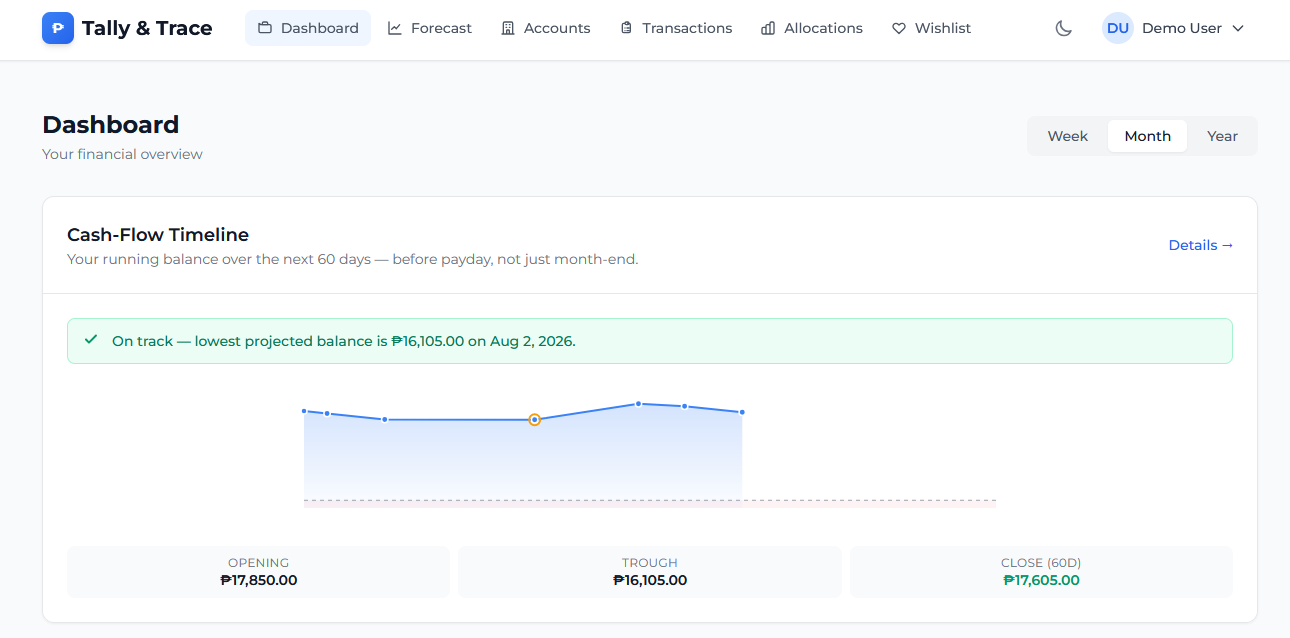
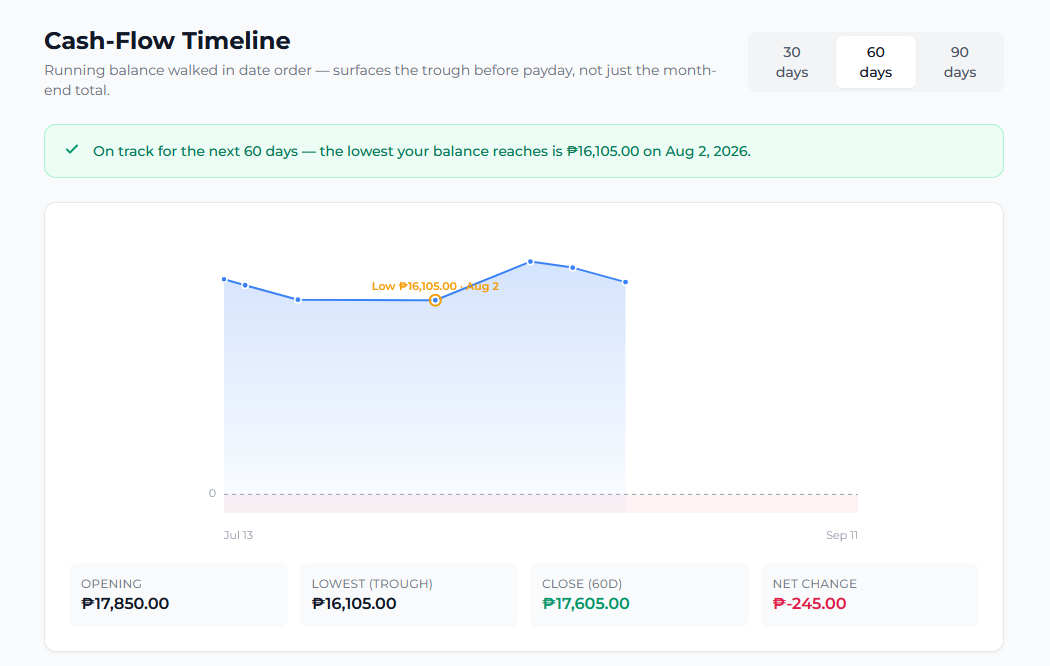
Seeing it. The engine feeds a dashboard hero card — a running-balance line with the trough marked and a red banner when there's a shortfall before payday — and a dedicated /forecast page with the full dated event table. The number we used to compute by hand is now the first thing you see on opening the app.
Acting on it. Seeing that a bill is due before payday is only half the job; you still have to pay it. So a due entry now has a "Mark paid" button that materialises it — posts a real transaction against the account, moves the balance, and rolls the recurring schedule to its next date. The satisfying part: rather than re-implement how a transaction touches balances and budget envelopes, materialisation calls the exact same code path as manually adding a transaction. One source of truth for money movement, so the two can't drift.
The rest of the spreadsheet. A wishlist with a priority-ordered "when can I afford each of these" plan derived from disposable income; category and entity management; and one-click JSON/CSV export of everything — because a budgeting tool you can't get your data out of is a trap, not a tool.
A quiet engineering win. Adding the new cadences surfaced a bug: the dashboard kept its own copy of the recurrence math, and it didn't know about biweekly or semi-monthly, so it was silently under-counting them. Rather than maintain two drifting copies, we pulled the occurrence generator into the shared package as a single, tested function — and added the project's first frontend tests (vitest) to pin it down. Backend (Python) and frontend (TypeScript) still each need their own implementation, but the TypeScript side now has one home and a suite guarding it.
Why this matters
The lesson here isn't really about cash flow. It's that a summary can be perfectly correct and still answer the wrong question. Our forecaster's month-end total was never wrong — every peso of it was accurate. It just wasn't the number that decides whether rent clears. Replacing a spreadsheet doesn't mean reproducing its cells; it means reproducing the judgment the person using it makes, and for us that judgment is a mid-month timing check, not a monthly sum.
It's also a small argument for auditing your own tool against the artifact it claims to replace. We'd been using Tally & Trace happily for months — while still quietly opening the spreadsheet at the end of every month to run the one check the app couldn't. That tell is the whole reason this post exists.
What's next
A few threads open from here. The next correctness piece is account-aware routing: we pay a specific card from the payroll account at the same bank first and only cover the overflow from checking, so the forecaster should model a per-payable funding source instead of pooling every account into one balance. Upcoming-bill notifications can fire on the lead time each entry already carries. And further out, the timeline is the foundation for the conversational layer we've been prototyping: once the app can answer "what's my lowest balance before payday, and what causes it," it can answer that out loud — through an assistant — without anyone opening a spreadsheet at all.
Related Project
Tally And Trace
A full-stack, type-safe financial management tool for personal and business finances
View project details →